
Update: The LangChain - SpiceDB library is now an official integration.
2025 was the year AI went mainstream - RAG pipelines, LLM-powered agents, and multi-step assistants are running in companies of all sizes. One of the most popular frameworks to build AI applications is LangChain, so we're happy to announce a LangChain-SpiceDB integration! And with this integration we hope to help you with something that can be tricky in the AI world - authorization.
While the fundamentals of access control remain the same for AI Agents, the surface area for data leakage explodes. For example, an AI assistant might retrieve sensitive data from a knowledge base that the requesting user doesn't have access to. Furthermore, using conventional access control methods such as Role-Based Access Control (RBAC) crumble when permissions are inherited and nested because they only check a coarse role (like employee) which is mapped to broad permissions.
This is where Relationship-Based Access Control (ReBAC) and SpiceDB shine as ReBAC prevents this scenario by explicitly modeling the user-resource relationships, ensuring the check respects all inherited permissions. Popularized in Google's 2019 Zanzibar paper, ReBAC focuses on relationships to determine permissions for specific resources. SpiceDB is the most scalable open-source implementation of Zanzibar, providing the low-latency, high-throughput authorization checks required for RAG and AI applications.
The langchain-spicedb library brings SpiceDB's authorization model into LangChain and LangGraph workflows, so you can build RAG pipelines that respect what users are allowed to see.
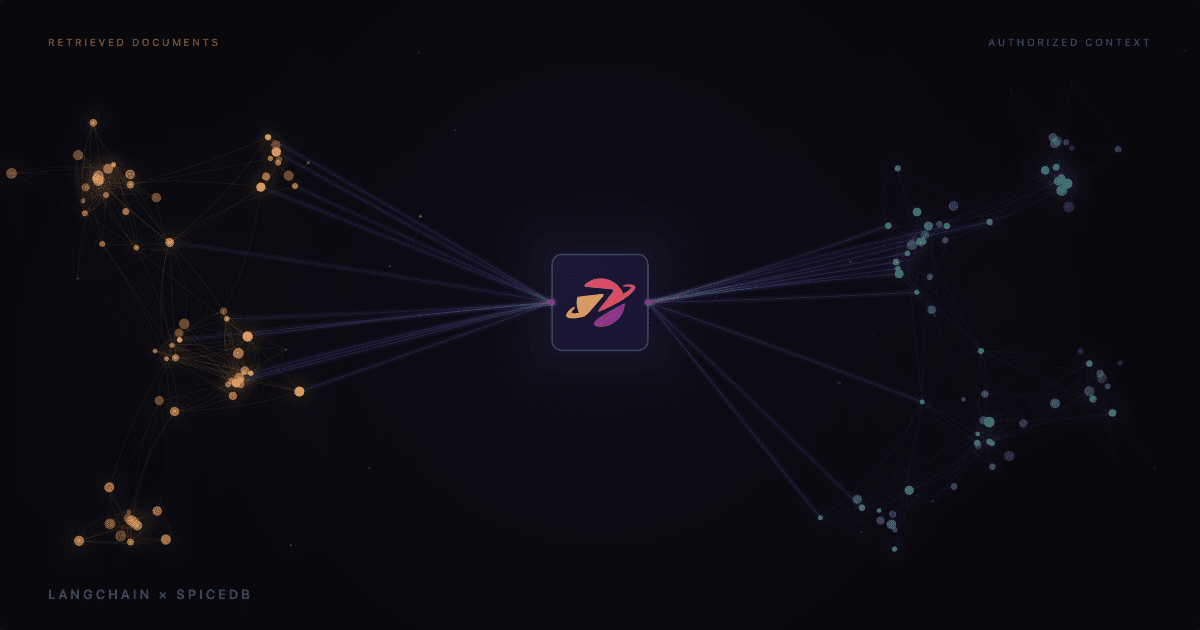
RAG pipelines minus permissions
Here's what the standard RAG flow looks like:
User asks a question → you embed it → you fetch the closest vectors → you hand those documents to an LLM → the LLM answers.
Nowhere in this flow is there a step that asks: does this user actually have permission to see these documents?
When authorization does get added, it usually arrives as RBAC: "this user has the employee role, employees can read public documents." Simple, but inadequate for anything involving multiple users with relationships to specific resources.
SpiceDB lets you model those relationships explicitly using schema:
definition user {}

definition article {
    relation viewer: user
    permission view = viewer
}
Then you ask: "Does Alice have view permission on article:doc123?" SpiceDB answers based on actual relationships in its graph, not a coarse role lookup.
Enter langchain-spicedb
We've published langchain-spicedb, an authorization library for RAG pipelines that plugs SpiceDB into LangChain and LangGraph. It's vector-store agnostic which means it works with Pinecone, Weaviate, Chroma, or anything that returns documents with metadata.
pip install langchain-spicedb[all]
The core pattern is post-retrieval filtering: retrieve the best semantic matches first, then check permissions for each document retrieved with the user's permissions by using metadata (such as a doc_id) before anything reaches the LLM. This ensures that the LLM doesn't access anything that the user is not supposed to view.
The library uses SpiceDB's CheckBulkPermissionsRequest API under the hood, so 100 documents cost one network call, not 100. API reference here
Three components, one decision
1. SpiceDBAuthFilter for LangChain chains
If you're building with LCEL, SpiceDBAuthFilter slots between your retriever and your LLM. User identity is passed at runtime via configurable, so you build the chain once and reuse it across users:
from langchain_spicedb import SpiceDBAuthFilter
from langchain_core.runnables import RunnableParallel, RunnablePassthrough
from langchain_core.output_parsers import StrOutputParser

auth = SpiceDBAuthFilter(
    spicedb_endpoint="localhost:50051",
    spicedb_token="sometoken",
    subject_type="user",
    resource_type="article",
    resource_id_key="article_id",
    permission="view",
)

chain = (
    RunnableParallel({
        "context": retriever | auth,  # authorization happens here
        "question": RunnablePassthrough(),
    })
    | prompt
    | llm
    | StrOutputParser()
)

# Same chain, different users
answer = await chain.ainvoke(
    "What is our litigation approach?",
    config={"configurable": {"subject_id": "alice"}}
)
If you'd rather bundle retrieval and authorization into a single BaseRetriever use SpiceDBRetriever instead. This approach is useful when dropping this into an existing pipeline that already expects a retriever.
from langchain_spicedb import SpiceDBRetriever

retriever = SpiceDBRetriever(
    base_retriever=vector_store.as_retriever(),
    subject_id="alice",
    spicedb_endpoint="localhost:50051",
    spicedb_token="sometoken",
    resource_type="article",
    resource_id_key="article_id",
)

docs = await retriever.ainvoke("query")
2. create_auth_node for LangGraph workflows
For stateful, multi-step LangGraph workflows, authorization becomes a node in your graph. create_auth_node() and RAGAuthState handle the wiring:
from langgraph.graph import StateGraph, END
from langchain_spicedb import create_auth_node, RAGAuthState

graph = StateGraph(RAGAuthState)

graph.add_node("retrieve", retrieve_node)
graph.add_node("authorize", create_auth_node(
    spicedb_endpoint="localhost:50051",
    spicedb_token="sometoken",
    resource_type="article",
    resource_id_key="article_id",
))
graph.add_node("generate", generate_node)

graph.set_entry_point("retrieve")
graph.add_edge("retrieve", "authorize")
graph.add_edge("authorize", "generate")
graph.add_edge("generate", END)

app = graph.compile()
result = await app.ainvoke({
    "question": "What is our litigation strategy?",
    "subject_id": "alice",
})
The auth node reads retrieved_documents from state, runs the permission check, and writes back authorized_documents plus auth_results - a metrics dict with retrieved count, authorized count, denied IDs, and check duration.
If you need to handle multiple resource types or conditional auth paths, extend RAGAuthState with your own fields, or use AuthorizationNode directly to build reusable nodes across graphs.
This example uses Weaviate as the Vector database along with a LangGraph workflow for Agentic RAG.
3. SpiceDBPermissionTool for agents
For LLM agents that need to check permissions before acting, the library ships with tools the agent can call directly:
from langchain_spicedb import SpiceDBPermissionTool

tool = SpiceDBPermissionTool(
    spicedb_endpoint="localhost:50051",
    spicedb_token="sometoken",
    subject_type="user",
    resource_type="article",
)

result = tool.invoke({
    "subject_id": "alice",
    "resource_id": "doc123",
    "permission": "view"
})
# Returns: "true" or "false"
SpiceDBBulkPermissionTool handles multiple resources in a single call.
One important note here is that Authorization is on the critical path so the AI agent should always perform an authorization check. Ensure that there's no Agent reasoning to decide whether an authorization check should be performed. This is an anti-pattern if the agent decides not to perform an authorization check, which could lead to data leakage.
A quick decision guide
- Simple LCEL chain? →
SpiceDBAuthFilter - Existing retriever-based pipeline? →
SpiceDBRetriever - Stateful, multi-step LangGraph workflow? →
create_auth_node - Agent that checks permissions on the fly? →
SpiceDBPermissionTool
The bigger picture
AI agents and LLMs now handle sensitive, dynamic data so ensuring a robust authorization layer is absolutely vital. The langchain-spicedb integration allows you to use powerful ReBAC to build genuinely secure AI applications and RAG pipelines, effectively closing the door on data leakage that conventional systems leave wide open. This is the critical component for trust in your AI infrastructure.
langchain-spicedb is on PyPI and GitHub. Try it, break it, and open an issue when you do.
Next steps
The PR to make it an official LangChain integration has been merged — see the official integration docs.
Here's a production-style example that uses Weaviate as the vector database and the LangGraph integration for fine-grained SpiceDB authorization.
If you're attending Kubecon Amsterdam, come join this LangChain meetup on March 26th where we'll demo this library. Swing by and say hi.